


|
Navigation: »No topics above this level« derivative |
  
|
Signal\Block Diagram
FO
Pure
Domains: Continuous. Size: 1-D. Kind: Block Diagrams.
This model calculates the derivative of an input signal. The initial value of the output is equal to the parameter "initial".
output = ddt(input,initial);
A pure derivative requires special integration methods like the BDF method (default in 20-sim). Therefore 20-sim will try solve pure derivatives during compilation. If symbolic solving of a derivative fails, the Process Tab will show that the model contains 1 or more dependent state. To prevent dependent states, it is better to use the first order (FO) approximation of a derivative.
Inputs |
Description |
input |
|
Outputs |
|
output |
|
Parameters |
|
initial |
The initial value of the output. |
This model is a first order (FO) approximation of a derivative. For low frequency signals, the model gives a good approximation of a pure derivative. The transfer function is:
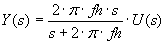
The parameter fh is the derivative bandwidth. This is the maximum frequency or which this model gives a good approximation of a pure derivative. This is clear from the bode plot below which show the lines for a pure derivative (dotted) and the first order approximation.

Interface - FO
Inputs |
Description |
input |
|
Outputs |
|
output |
|
Parameters |
|
fh |
Differentiation bandwidth [Hz] |
Initial Values |
|
output_initial |
The initial value of the output. |